Best Smart Thermostats to Cut Your Bill

Heating and cooling typically account for the largest single share of a home’s energy bill, which makes a smart thermostat one of the highest-impact smart home upgrades available for the price. But not every model delivers the same savings or the same experience — some prioritize learning your schedule automatically, others prioritize simplicity and no subscription, and some are built specifically for homes with multiple heating and cooling zones. We ranked the leading options by the priorities that matter most, so you can pick the thermostat that actually fits your home, your budget, and your daily habits.
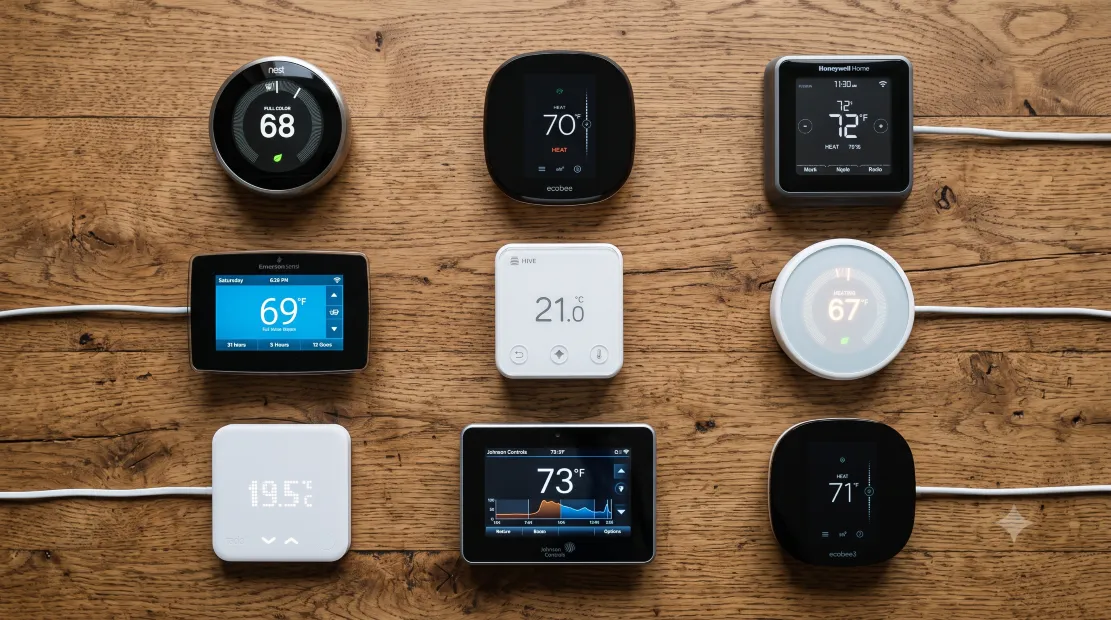
A smart thermostat is one of the highest-impact, lowest-cost energy-saving upgrades for most homes.
⚡ Quick Answer
- Best overall: Ecobee SmartThermostat — remote sensors and strong energy reporting make it the most complete package.
- Best for energy savings: Google Nest Learning Thermostat — automatic schedule learning adapts to your habits without manual setup.
- Best no-subscription option: Emerson Sensi — full smart features without a mandatory monthly fee.
- Best for multi-zone homes: Ecobee with remote sensors — balances temperature across rooms rather than relying on one central reading.
How We Ranked These
Rankings are based on the factors that matter most for actually cutting your bill: automated scheduling and learning capability, energy usage reporting and insights, remote sensor support for multi-room accuracy, app quality, and subscription requirements. We also weighed HVAC compatibility and installation complexity, since a thermostat that doesn’t work with your specific heating and cooling system delivers no value regardless of its feature list, and no single model wins every category outright.
1. Best Overall: Ecobee SmartThermostat
Ecobee’s flagship model earns the top overall spot through its combination of remote room sensors, detailed energy reporting, and strong third-party smart home integration. The included remote sensor measures temperature and occupancy in a specific room away from the thermostat itself, letting the system average or prioritize readings from where people actually are rather than relying solely on the thermostat’s own location — a meaningful accuracy improvement for homes where one room runs noticeably hotter or colder than the thermostat’s hallway location suggests. Detailed monthly energy reports also help identify exactly where savings are and aren’t showing up across each billing cycle.
Best for: buyers wanting the most complete, accurate package with strong energy insights and multi-room awareness.
2. Best for Energy Savings: Google Nest Learning Thermostat
Nest’s Learning Thermostat pioneered the automatic schedule-learning approach that’s now common across the category, and it remains one of the strongest performers for genuine energy savings without requiring manual schedule setup. By observing your manual temperature adjustments over the first week or two of use, it builds an automated schedule that adapts to your actual patterns rather than a generic default, and its energy history reports clearly show usage trends over time. Third-party independent studies have generally found meaningful heating and cooling savings for households switching from a traditional thermostat.
Best for: households that want automated savings without manually programming a detailed schedule themselves.
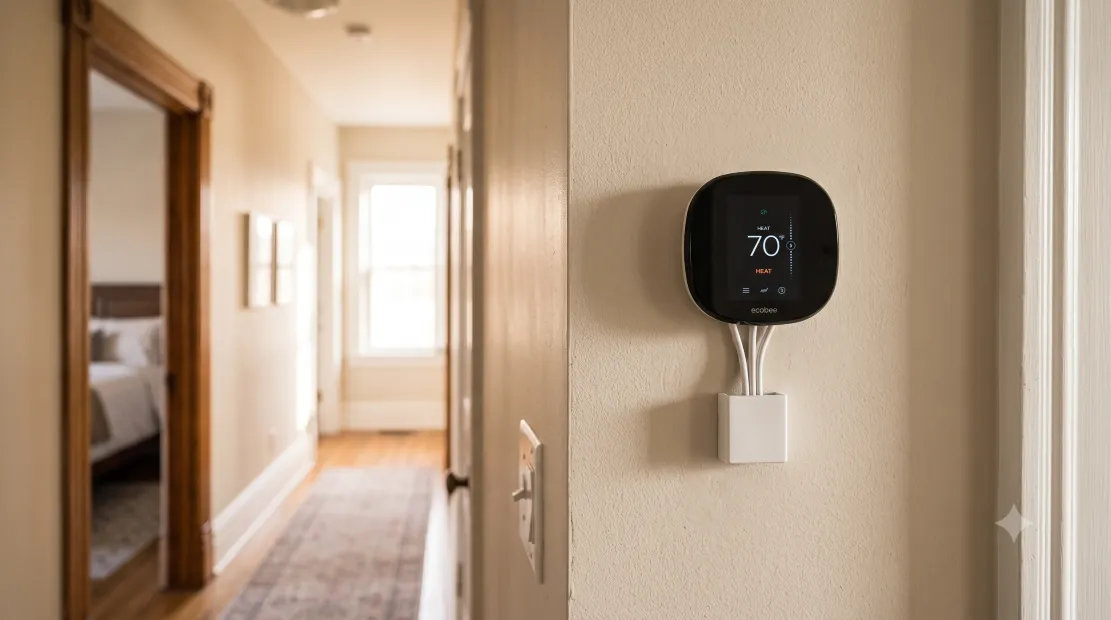
Smart thermostats have become one of the most common entry points into home energy savings.
3. Best No-Subscription Option: Emerson Sensi
Emerson’s Sensi lineup delivers full remote control, scheduling, and geofencing (adjusting temperature based on whether your phone indicates you’re home or away) without requiring a mandatory subscription for core functionality — a genuine differentiator from some competitors that gate advanced features behind a paid tier. Build quality and app polish are solid, if slightly less feature-dense than Ecobee or Nest’s most advanced tiers, but for buyers specifically prioritizing zero recurring cost, Sensi delivers nearly everything most households actually need.
Best for: buyers who want full smart thermostat functionality without any ongoing subscription cost.
4. Best for Multi-Zone Homes: Ecobee with Remote Sensors
Homes with uneven heating or cooling across different rooms — a common issue in larger or oddly-laid-out homes — benefit most from Ecobee’s remote sensor system, which can be expanded with additional sensors placed in multiple rooms beyond the single included unit. This lets the thermostat balance its heating and cooling decisions based on multiple room readings rather than a single point of measurement, directly addressing the uneven-temperature problem that a standard single-sensor thermostat can’t solve on its own.
Best for: larger homes or homes with noticeably uneven temperatures between rooms.
| Category | Top Pick | Why |
|---|---|---|
| Best Overall | Ecobee SmartThermostat | Remote sensors, strong energy reporting |
| Best for Energy Savings | Google Nest Learning Thermostat | Automatic schedule learning |
| Best No-Subscription | Emerson Sensi | Full features without a monthly fee |
| Best for Multi-Zone Homes | Ecobee + remote sensors | Balances readings across multiple rooms |
| Best Budget | Honeywell Home / Wyze | Core smart features at a lower price |
5. Best Budget: Honeywell Home and Wyze
For buyers who want basic app control and scheduling without paying for advanced sensor systems or the deepest energy reporting, Honeywell Home and Wyze both offer capable entry-level smart thermostats at a meaningfully lower price than Ecobee or Nest’s flagship models. These budget options generally lack remote room sensors and the most sophisticated learning algorithms, but they still deliver the core value proposition — remote control, basic scheduling, and geofencing — that accounts for much of a smart thermostat’s everyday savings potential.
Best for: budget-conscious buyers who want the core smart thermostat benefits without paying for premium sensor and reporting features.
How Much Can a Smart Thermostat Actually Save?
Savings vary by climate, home insulation, and prior thermostat habits, but studies from thermostat manufacturers and independent energy researchers generally point to meaningful heating and cooling savings for households switching from a manual, non-programmable thermostat to a smart model with automated scheduling. Households that were already diligent about manually adjusting a programmable thermostat see smaller incremental gains, since much of the savings potential comes from replacing inconsistent manual habits with automated, optimized scheduling rather than from the hardware itself being inherently more efficient.
HVAC Compatibility: Check Before You Buy
Not every smart thermostat works with every heating and cooling system, particularly older systems, systems without a common (“C”) wire, or specialized systems like heat pumps with auxiliary heat strips. Most manufacturers offer an online compatibility checker where you enter your existing thermostat’s wiring configuration to confirm compatibility before purchasing — a step worth taking seriously, since discovering an incompatibility after opening the box (and removing your old thermostat) is a far more frustrating position than checking in advance.
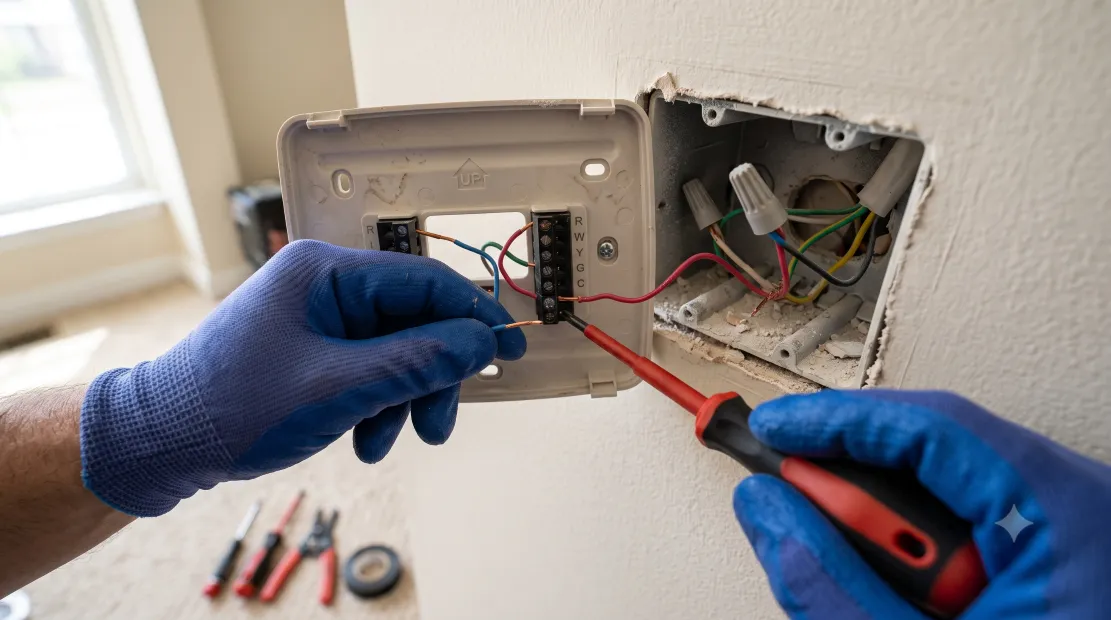
Confirming HVAC wiring compatibility before purchase avoids installation surprises.
DIY Installation vs Professional Help
Most smart thermostats are designed for DIY installation, typically taking 30-60 minutes for someone comfortable with basic wiring and following the manufacturer’s step-by-step app-guided instructions. Homes with more complex HVAC systems, multiple heating and cooling stages, or uncertain existing wiring configurations may benefit from professional installation to avoid compatibility issues or wiring mistakes. Most manufacturers or local HVAC companies offer installation service for a modest additional fee if DIY installation feels outside your comfort level.
Geofencing and Occupancy Detection
Most models in this ranking support geofencing, using your phone’s location to automatically adjust temperature when you’re away from home and restore comfortable settings as you approach, without requiring manual schedule changes for irregular days. Ecobee’s approach adds occupancy sensing through its remote sensors, detecting actual presence in specific rooms rather than relying solely on phone location — a more granular signal that can catch scenarios geofencing alone might miss, such as someone home without their phone, or specific rooms being unused even while the house overall is occupied.
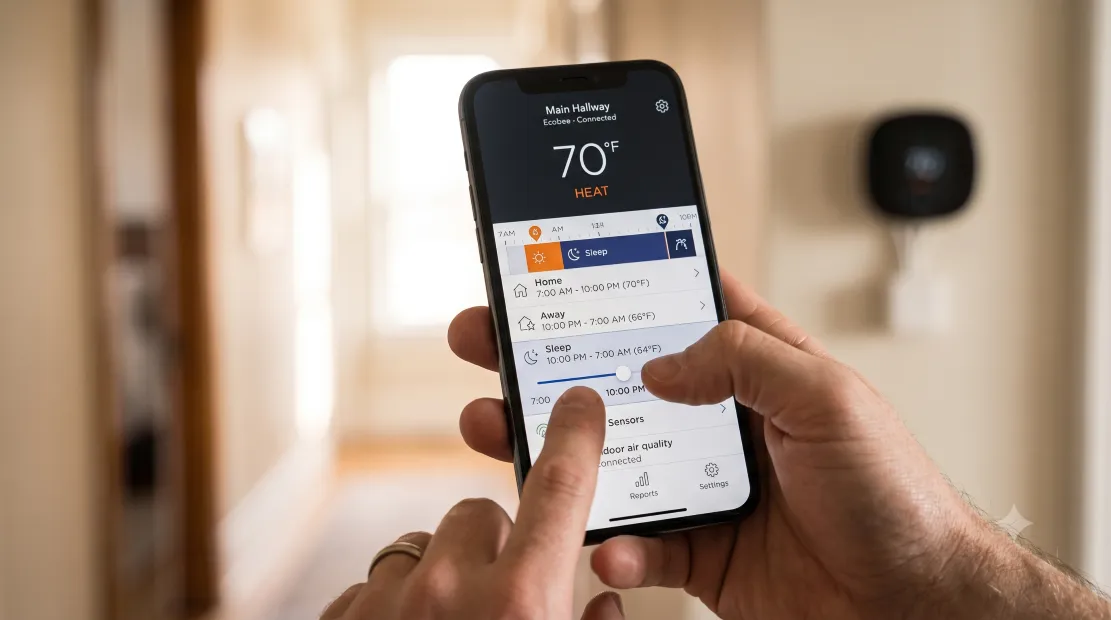
App-based scheduling and geofencing form the core of most smart thermostat energy savings.
Energy Reporting: Turning Data Into Savings
Beyond automated scheduling, detailed energy usage reports help identify specific opportunities to save further — showing how much runtime went to heating versus cooling, how outdoor temperature affected usage, and how your usage compares to similar homes in your climate. Ecobee and Nest both offer particularly detailed reporting in this category, while budget-tier thermostats generally provide more basic usage summaries without the same depth of comparative insight.
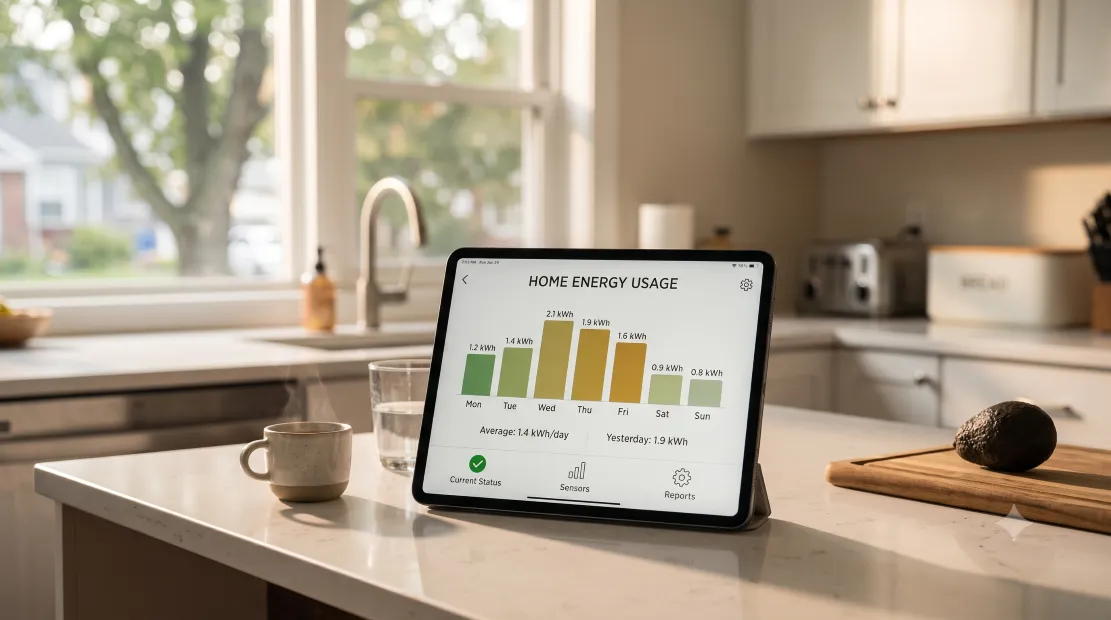
Detailed energy reports help identify specific opportunities for further savings beyond automated scheduling.
Smart Home Ecosystem Integration
Every thermostat in this ranking supports integration with major smart home platforms, letting temperature control tie into broader automation routines alongside other smart home devices. This matters most for households building out a broader smart home system, where a thermostat that plays well with existing smart speakers, sensors, and routines adds more value than one that operates in isolation from everything else in the home.
Battery vs Hardwired Power
Most smart thermostats can run on either battery power or a common wire connection from the HVAC system, with hardwired power generally recommended when available since it avoids the inconvenience of periodic battery replacement and ensures the display and WiFi connection stay active continuously. Some models default to battery operation with the common wire as a backup or charging source, while others require the common wire outright for full functionality — worth checking against your specific model and existing wiring situation before installation.
Multi-Stage and Heat Pump Compatibility
Homes with multi-stage heating or cooling systems, or heat pumps with auxiliary heat strips, require thermostats specifically compatible with these more complex system types rather than a basic single-stage model. Ecobee and Nest both offer strong compatibility with multi-stage and heat pump systems in their flagship models, correctly managing the more nuanced staging logic these systems require, while some budget-tier thermostats may only support basic single-stage conventional systems. Confirming your specific system type against a thermostat’s supported configurations list is an important step for anyone with a heat pump or multi-stage HVAC setup.
How to Choose the Right One for You
Start with HVAC compatibility, since it’s a hard requirement rather than a preference — confirm your specific system works with your top candidate before falling in love with any particular model’s features. From there, weigh your priorities: multi-room temperature accuracy points toward Ecobee, hands-off automated learning points toward Nest, avoiding subscriptions points toward Emerson Sensi, and budget constraints point toward Honeywell Home or Wyze. Whichever you choose, consistent use of the scheduling and geofencing features matters more to your actual savings than which specific premium features you paid extra for.
Frequently Asked Questions
What is the best smart thermostat overall?
The Ecobee SmartThermostat currently offers the strongest overall package, combining remote room sensors, detailed energy reporting, and broad smart home integration, making it the top pick for most households, particularly those with uneven room temperatures.
How much money can a smart thermostat actually save?
Savings vary by climate and prior habits, but households switching from a manual or non-programmable thermostat generally see meaningful heating and cooling savings. Households already using a programmable thermostat consistently see smaller incremental gains.
Which smart thermostat doesn’t require a subscription?
Emerson Sensi delivers full remote control, scheduling, and geofencing without a mandatory monthly subscription, making it the strongest choice for buyers who want to avoid recurring fees.
Will a smart thermostat work with my HVAC system?
Most modern HVAC systems are compatible, but older systems or those without a common wire may need an adapter or additional wiring. Use the manufacturer’s online compatibility checker with your existing wiring configuration before purchasing to confirm.
Can I install a smart thermostat myself?
Yes, most models are designed for DIY installation in 30-60 minutes with app-guided instructions. Homes with more complex HVAC systems or uncertain wiring may benefit from professional installation to avoid compatibility issues.
ADeeL A.M
ADeeL A.M is a home energy and clean solar power writer with a deep passion for the electrified home. He spends his days researching solar panels, battery backup systems, EV chargers, portable power stations, and smart energy solutions — comparing specs, efficiency ratings, and real-world performance to bring readers the newest, most reliable, and best-value options on the market.
View all articles by ADeeL A.M →